
High-yield savings accounts can be convenient. They offer simple access, FDIC insurance within limits, and rates that often look competitive at first glance. But for Californians, Treasury Bills can offer a powerful advantage: T-Bill interest is exempt from California state income tax, while HYSA interest is fully taxable at both the federal and state level.
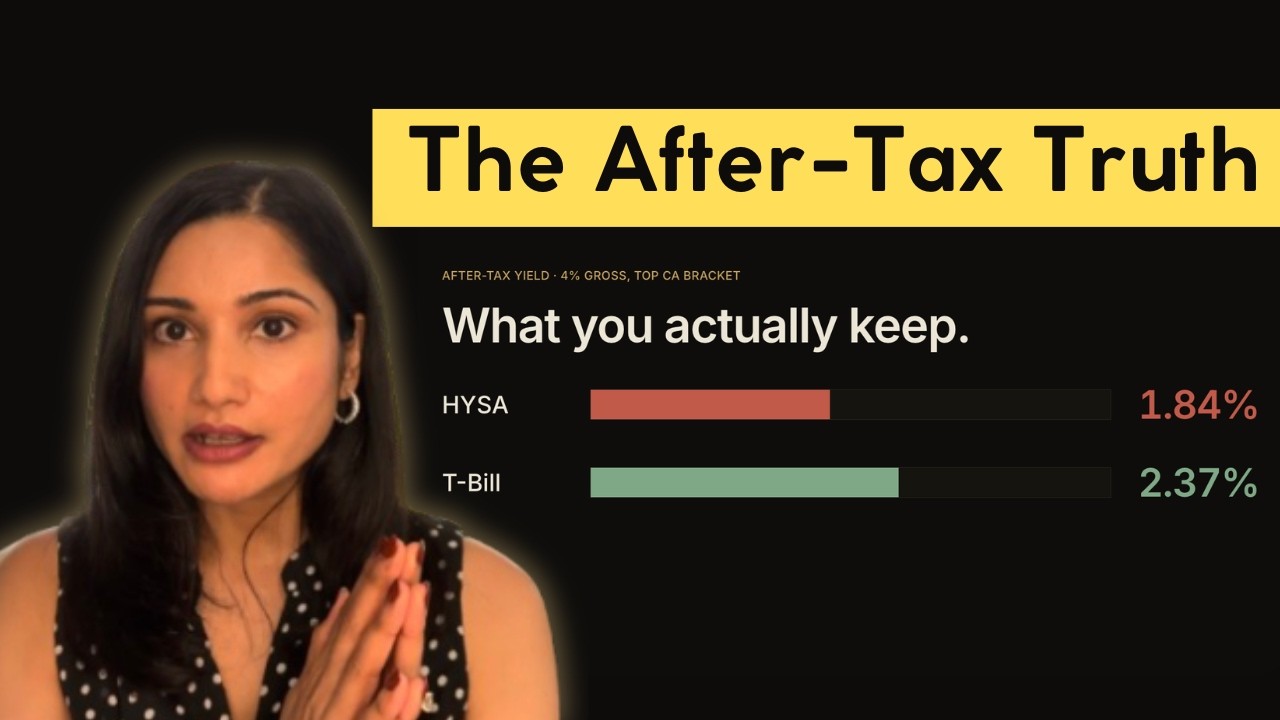
At a 4% gross yield, a top-bracket California household may keep roughly 2.37% after tax from Treasury Bills versus about 1.84% after tax from an HYSA. That means the same headline yield can produce roughly 29% more after-tax income with Treasury Bills.
For high-income California households, that difference can be meaningful.
Key Takeaways
- Treasury Bill interest is exempt from California income tax, while HYSA interest is fully taxable by California.
- At a 4% gross yield, T-Bills may deliver roughly 29% more after-tax income than an HYSA for a top-bracket California household.
- The advantage grows as income rises, especially for households in California's top tax brackets.
- T-Bill yields are locked in at purchase, while HYSA rates can be changed by the bank at any time.
- Treasury Bills are backed by the full faith and credit of the U.S. government and do not have the same $250,000 FDIC coverage cap that applies to bank deposits.
- Direct T-Bills avoid fund expense ratios, which can matter for larger cash balances.
- Liquidity still matters: HYSAs are better for immediate cash needs, while T-Bill ladders can work well for 1- to 12-month cash reserves.
Why Treasury Bills Have a Tax Advantage in California
Treasury Bill interest is taxable at the federal level, but it is generally exempt from state and local income tax. HYSA interest, by contrast, is taxed as ordinary income federally and is also taxable in California.
For a top-bracket California household, the difference can look like this:
| Tax Layer | HYSA Interest | Treasury Bill Interest |
|---|---|---|
| Federal ordinary income tax | 37% | 37% |
| Net Investment Income Tax | 3.8% | 3.8% |
| California income tax | Up to 13.3% | 0% |
| Combined marginal tax rate | Up to 54.1% | 40.8% |
- HYSA Interest
- 37%
- Treasury Bill Interest
- 37%
- HYSA Interest
- 3.8%
- Treasury Bill Interest
- 3.8%
- HYSA Interest
- Up to 13.3%
- Treasury Bill Interest
- 0%
- HYSA Interest
- Up to 54.1%
- Treasury Bill Interest
- 40.8%
At the same 4% gross yield:
| Vehicle | Gross Yield | Approx. After-Tax Yield |
|---|---|---|
| Treasury Bill | 4.00% | 2.37% |
| HYSA | 4.00% | 1.84% |
- Gross Yield
- 4.00%
- Approx. After-Tax Yield
- 2.37%
- Gross Yield
- 4.00%
- Approx. After-Tax Yield
- 1.84%
T-Bills deliver roughly 29% more after-tax income at the same headline yield.
Calculation:
- Treasury Bill after-tax yield: 4.00% x (1 - 40.8%) = 2.37%
- HYSA after-tax yield: 4.00% x (1 - 54.1%) = 1.84%
That means the Treasury Bill can deliver roughly 29% more after-tax income than an HYSA with the same headline yield for a top-bracket California household.
The same concept applies at lower tax brackets too. The exact spread depends on your federal bracket, California bracket, filing status, and whether the Net Investment Income Tax applies, but the direction is usually the same: California residents often keep more of their cash yield with Treasury Bills than with bank interest.
What About the SALT Deduction?
The higher federal SALT deduction cap may modestly improve the HYSA comparison for some taxpayers because a portion of California tax paid on HYSA interest may be deductible federally if the taxpayer itemizes.
However, this does not eliminate the core advantage of Treasury Bills.
For 2025, the federal SALT deduction cap is $40,000 for most filers, with a reduction beginning above $500,000 of modified adjusted gross income. The cap cannot be reduced below $10,000. For many high-income California households, especially those already paying substantial state income tax and property tax, the SALT cap may already be used up before HYSA interest is considered.
In other words: the SALT deduction may soften the difference in some cases, but it generally does not make HYSA interest as tax-efficient as Treasury Bill interest for high-income Californians.
Treasury Bills vs. HYSAs vs. Money Market Funds vs. Brokered CDs
For California residents, it is helpful to compare the main cash options side by side.
| Feature | Treasury Bills | HYSA | Government Money Market Fund | Brokered CD |
|---|---|---|---|---|
| Yield | Often competitive with top cash products | Variable by bank | Often competitive | Often competitive |
| Yield locked? | Yes, until maturity | No | No | Yes, until maturity |
| California tax-exempt? | Yes | No | Sometimes | No |
| Federal tax? | Yes | Yes | Yes | Yes |
| Approx. after-tax yield at 4% gross yield, top CA bracket | ~2.37% | ~1.84% | ~1.84%-2.37% | ~1.84% |
| Liquidity | Sellable before maturity; laddering improves access | Same-day or near same-day | Same-day or next-day | Limited; may require secondary sale |
| Safety | U.S. government backing | FDIC up to limits | Depends on holdings | FDIC up to limits if issued by insured bank |
| Expense ratio | None if bought directly | None | Fund expense ratio | None directly, but pricing/spreads may apply |
- Treasury Bills
- Often competitive with top cash products
- HYSA
- Variable by bank
- Government Money Market Fund
- Often competitive
- Brokered CD
- Often competitive
- Treasury Bills
- Yes, until maturity
- HYSA
- No
- Government Money Market Fund
- No
- Brokered CD
- Yes, until maturity
- Treasury Bills
- Yes
- HYSA
- No
- Government Money Market Fund
- Sometimes
- Brokered CD
- No
- Treasury Bills
- Yes
- HYSA
- Yes
- Government Money Market Fund
- Yes
- Brokered CD
- Yes
- Treasury Bills
- ~2.37%
- HYSA
- ~1.84%
- Government Money Market Fund
- ~1.84%-2.37%
- Brokered CD
- ~1.84%
- Treasury Bills
- Sellable before maturity; laddering improves access
- HYSA
- Same-day or near same-day
- Government Money Market Fund
- Same-day or next-day
- Brokered CD
- Limited; may require secondary sale
- Treasury Bills
- U.S. government backing
- HYSA
- FDIC up to limits
- Government Money Market Fund
- Depends on holdings
- Brokered CD
- FDIC up to limits if issued by insured bank
- Treasury Bills
- None if bought directly
- HYSA
- None
- Government Money Market Fund
- Fund expense ratio
- Brokered CD
- None directly, but pricing/spreads may apply
Government money market funds deserve special attention. Some funds may pass through state-tax-exempt income if they hold enough qualifying U.S. government obligations, but not all funds qualify. California generally requires the fund to meet a threshold for U.S. government obligations before the exemption can flow through. This means investors should check the fund's annual tax information letter before assuming the income is exempt from California tax.
Why HYSA Rates Are Less Predictable
HYSA rates are set by banks. They can change at the bank's discretion, especially when the Federal Reserve lowers interest rates. A bank may advertise a highly competitive rate today and reduce it later.
Treasury Bills work differently. When you buy a T-Bill at auction or in the secondary market, your yield is locked in for that bill's term. A 13-week, 26-week, or 52-week Treasury Bill gives you a known return if held to maturity.
That does not mean T-Bills eliminate all reinvestment risk. When the bill matures, the next available yield may be higher or lower. But during the holding period, the yield is fixed.
A simple ladder can help manage this. For example, an investor might spread cash across 4-week, 8-week, 13-week, 26-week, and 52-week Treasury Bills so that a portion of the cash matures regularly.
Why Buy Treasury Bills Directly Instead of Using an ETF or Fund?
Treasury ETFs and Treasury money market funds can be convenient, and for smaller balances they may be perfectly reasonable. Funds such as short-term Treasury ETFs can offer easy trading, simple reinvestment, and daily liquidity.
However, buying Treasury Bills directly has several advantages.
1. No Expense Ratio
Treasury ETFs and money market funds charge expense ratios. The fees may be small, but they still reduce the yield you keep. When you buy T-Bills directly, there is no fund-level expense ratio.
2. Clearer California Tax Treatment
Direct Treasury Bill interest is straightforward: it is generally exempt from California income tax.
Funds require more review. A Treasury-only ETF will usually be cleaner than a broader government money market fund, but investors should still review the fund's tax information letter. Some government money market funds hold a mix of Treasuries, agencies, repos, and other instruments, which can affect whether the California exemption applies.
3. No Fund Price Volatility If Held to Maturity
With a direct T-Bill, you know the maturity date and face value. If you hold to maturity, the U.S. Treasury pays the full face amount.
With an ETF or fund, the market price or net asset value can fluctuate. For very short-duration Treasury funds, the movement may be small, but it is still different from holding a specific T-Bill to maturity.
Liquidity: Where HYSAs Still Win
HYSAs have one major advantage: immediate access.
If you need money available within hours or the next business day, an HYSA or brokerage cash sweep may be more practical. This makes HYSAs useful for true emergency funds, monthly operating cash, or money that may be needed on very short notice.
Treasury Bills are still liquid, but they are not the same as a checking or savings account. You can usually sell a T-Bill in the secondary market before maturity through a brokerage account, but the sale price may fluctuate with interest rates. If rates have risen since you purchased the bill, you could sell for slightly less than expected.
A ladder helps reduce this issue. By staggering maturities, you can create regular cash access without relying on early sales.
A practical approach for many California households is:
| Cash Need | Better Fit |
|---|---|
| Immediate emergency cash | HYSA or brokerage cash sweep |
| Cash needed within 1-4 weeks | HYSA, money market fund, or short T-Bill ladder |
| Cash needed in 1-12 months | Treasury Bills or T-Bill ladder |
| Large cash balance above FDIC limits | Treasury Bills or diversified custody structure |
- Better Fit
- HYSA or brokerage cash sweep
- Better Fit
- HYSA, money market fund, or short T-Bill ladder
- Better Fit
- Treasury Bills or T-Bill ladder
- Better Fit
- Treasury Bills or diversified custody structure
FDIC Limits vs. Treasury Backing
High-yield savings accounts are generally FDIC-insured up to $250,000 per depositor, per insured bank, per ownership category. That is strong protection for many households.
But for balances above FDIC limits, investors may need to spread deposits across multiple banks or use special cash-sweep programs to maintain full insurance coverage. This can become operationally cumbersome for households holding $500,000, $1 million, or more in cash.
Treasury Bills do not have an FDIC insurance cap. They are direct obligations of the U.S. government and are backed by the full faith and credit of the United States. For larger cash balances, that can make Treasury Bills both simpler and more tax-efficient.
When an HYSA May Still Make Sense
Treasury Bills are not always the right answer for every dollar of cash.
An HYSA may still make sense when:
- You need same-day or near-immediate liquidity.
- The balance is small and simplicity matters more than tax optimization.
- You do not want to manage auctions, maturities, or brokerage purchases.
- You are holding short-term cash for bills, payroll, or emergency needs.
- You are not in a high California tax bracket and the after-tax difference is small.
The key is not to treat every cash dollar the same. Immediate cash and strategic cash can be managed differently.
Bottom Line
For California residents, Treasury Bills often provide a stronger after-tax cash strategy than high-yield savings accounts.
The headline yield may look similar, but the tax result is different. HYSA interest is taxable by California. Treasury Bill interest is generally exempt from California income tax. At a 4% gross yield, a top-bracket California household may keep about 2.37% after tax with Treasury Bills compared with about 1.84% after tax from an HYSA.
HYSAs still have a role for immediate liquidity. But for cash that can be invested for several weeks to several months, especially larger balances, a direct Treasury Bill strategy or T-Bill ladder can provide:
- higher after-tax yield
- predictable income through maturity
- direct U.S. government backing
- no fund expense ratio
- simpler treatment for large balances above FDIC limits
For high-income Californians, the right question is not just, "What rate am I earning?" It is, "What do I keep after taxes, fees, and liquidity needs?"